
Polaris
The Polaris Identity Provider (IdP) is a secure authentication service used to verify user identities before granting access to systems and applications. It acts as a trusted gateway that confirms who a user is, using industry-standard authentication methods, and then allows the user to access services without repeatedly entering credentials.
Polaris supports modern security protocols such as SAML (Security Assertion Markup Language) and OAuth/OpenID Connect, enabling seamless single sign-on (SSO) across multiple platforms. This means users can authenticate once with Polaris and access all connected systems without having to log in again.
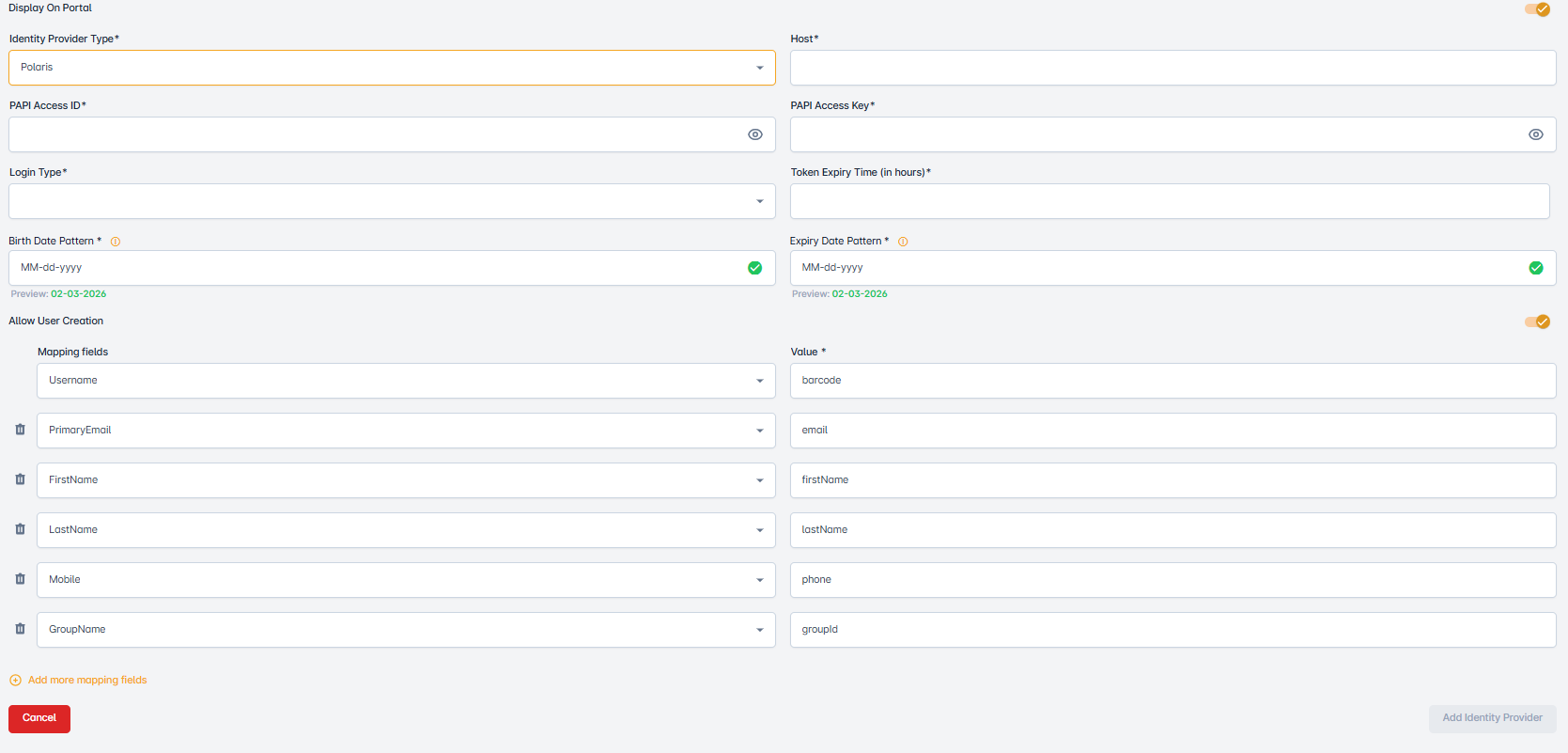
Display on Portal
Controls whether the identity provider is shown as a login option on the user-facing login portal.
Identity Provider Type
Refers to the category or specification of an identity provider used for authentication and authorization services, often in the context of single sign-on (SSO) and user access management. From this dropdown, select the OpenID Connect Identity Provider.
PAPI Access ID
PAPI Access Key
LoginType
Suggests the use of an advanced or cutting-edge identity provider for authentication and authorization, likely employing modern techniques and technologies for user access management. The specific methods and features can vary widely depending on the provider and its innovative approaches to identity and security. From this dropdown, select the LoginType Identity Provider. There are two options:
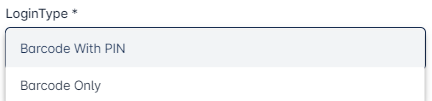
Barcode with PIN
Refers to a security or authentication method where a barcode (such as a QR code) and a personal identification number (PIN) are used in combination for user verification and access control. This dual-factor authentication approach enhances security by requiring both something the user knows (the PIN) and something the user has (the barcode) for authentication.
Barcode Only
Refers to a method of authentication or identification that relies solely on a barcode, such as a QR code, to verify and provide access to a system, service, or information. It does not involve the use of additional factors like a PIN or password.
Token Expiry Time(in hours)
Refers to the period during which a security token, such as an access token or session token, remains valid for authentication or authorization purposes. Enter the Token Expiry Time here in hours.
Birth Date Pattern
This field defines the format in which a user’s birth date must be entered or displayed in the system to be used in Easybooking group.
The pattern specifies the order and structure of day, month, and year (for example: DD/MM/YYYY or MM-DD-YYYY).
Using the correct pattern ensures that the birth date is recognized, validated, and processed correctly by the system.
Expiry Date Pattern
This field defines the format in which an expiry date must be entered or displayed. It specifies the order and structure of the date elements (day, month, year) so the system can correctly interpret and validate the expiry date, in Easybooking group.
Examples:
MM/YY→ Month and year (e.g.,08/26)MM/YYYY→ Month and full year (e.g.,08/2026)DD/MM/YYYY→ Day, month, and year (e.g.,15/08/2026)
Mapping field
Is a term commonly used in data integration and transformation. It typically refers to a data field that links or associates data from one source to a corresponding field in another source. Here are multiple dropdowns. From these dropdowns, select the mapping variables.
Value
The data within a mapping field that connects or associates data from one source with its counterpart in another source, facilitating data integration and transformation. Here are multiple dropdowns. From these dropdowns, select the mapping values.